SIMATIC S7-1200 Advanced Controllers
SIMATIC STEP 7 Engineering software
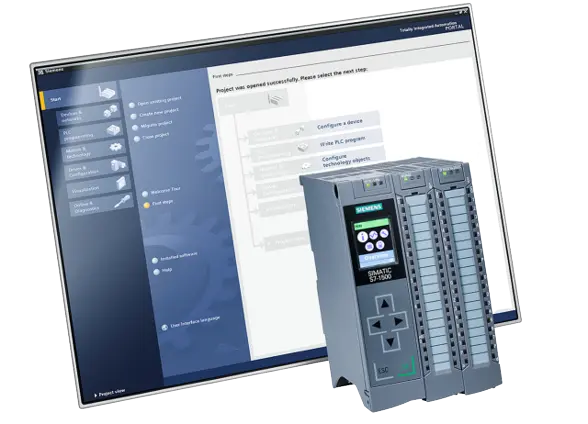
SIMATIC STEP 7 in TIA Portal is the comprehensive engineering tool for configuring and programming SIMATIC controllers, whether PLC- or PC-based.
SIMATIC STEP 7 Professional (TIA Portal) can be used to configure, program, test, and diagnose all generations of SIMATIC controllers.
SIMATIC STEP 7 Basic (TIA Portal) is the price-optimized subset of STEP 7 Professional software that can be used both for engineering the SIMATIC S7-1200 Basic Controllers and for configuring the SIMATIC HMI Basic Panels, because WinCC Basic is part of the software package.
SIMATIC STEP 7 Safety Engineering software
All configuration and programming tools required for generating a safety-oriented program are integrated into the STEP 7 user interface and use a common project structure. Using the SIMATIC STEP 7 Safety Basic or STEP 7 Safety Advanced (TIA Portal) option, you can also take advantage of all the benefits of the TIA Portal for your fail-safe automation.To use this option package, a valid SIMATIC STEP 7 Basic or STEP 7 Professional license is required.
STEP 7 Safety is the seamless integration of safety in TIA Portal. However, safety-oriented programs can still be generated using STEP 7 and Distributed Safety. Programs created with STEP 7 Distributed Safety can be migrated to TIA Portal at any time.
Application
- Planning, configuring and parameterization of hardware and communication.
- Creation of a user program.
- Documentation.
- Testing, startup and service.
- Process control.
Functions
- All project data (e.g. symbol tables, configuration data and parameter assignment data) are stored in a central database. They are available for all tools. This saves time and reduces errors from multiple entries.
- The SIMATIC programming languages comply with the standard EN 6.1131-3. This reduces the familiarization and training overhead.
- Completed program components can be stored in libraries and need only be copied over for subsequent projects.
- Subdividing a system into various projects allows you to distribute the processing to different personnel.
- Integral diagnostics functions reduce downtimes and the costs associated with them.